Eric Voegelin and the Continental Tradition: Explorations in Modern Political Thought (ERIC VOEGELIN INST SERIES) by Lee Trepanier & Steven F. McGuire
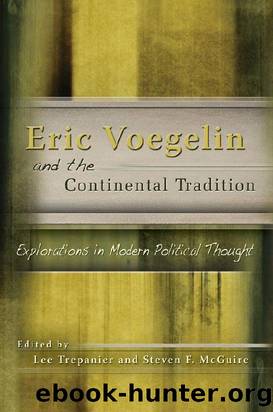
Author:Lee Trepanier & Steven F. McGuire [Trepanier, Lee & McGuire, Steven F.]
Language: eng
Format: epub
Tags: eric voegelin, filosofia política, Filosofia moderna
Publisher: University of Missouri Press
Published: 2011-02-14T03:00:00+00:00
6
Eric Voegelin and Neo-Kantianism
Early Formative Experience or Late Entrapment?
Arpad Szakolczai
This chapter aims to assess the character and significance of Eric Voegelin's formation within the neo-Kantian philosophical school. While the basic facts concerning this formative experience are well known, the exact nature (tone, character) of this formation has not been identified so far in a satisfactory manner. It will be argued that, far from being a matter of specialist interest, clarifying the exact nature of this link is vital for understanding certain short-comings of Voegelin's work: its fragmentary, unfinished character and the persistent failure to give a precise elaboration of one of his greatest insights, the Gnostic character of the modern world.
Ever since Voegelin came up with the striking characterization of modernity as an outright “Gnostic revolution” in The New Science of Politics, scholars both favorable and hostile to his work have debated the significance of this diagnosis. Even some of those generally sympathetic often have come to view this idea as questionable, even as a piece of cold war rhetoric, while others have insisted on considering it as pivotal.1 In any case, the task continues of explaining why the remaining three decades were not sufficient for Voegelin to substantiate the hypothetical diagnosis. Instead, charges of Gnosticism were voiced against a great number of thinkers and intellectual movements, including Hegel, Comte, Marx, Nietzsche, and Heidegger, just as positivism, socialism, or Nazism, without a clear account of the rise and dynamics of modern Gnosticism and a straightforward specification of who should be considered as Gnostic and why.
A hint toward the solution is given by some significant omissions in the list of Gnostic culprits: the name of Kant and the neo-Kantians, with whom Voegelin studied. This strongly supports the hypothesis, voiced by Rossbach and Shillabeer, that the incomplete character of Voegelin's lifework is somehow related to his failure to see himself as necessarily part of the Gnostic landscape.2 This chapter argues that this failure is linked to certain aspects of his formation in the intellectual context of neo-Kantianism.
The central part of the paper will therefore reconstruct, as far as possible, Voegelin's formation by neo-Kantianism. In order to understand the character of the neo-Kantian “appeal,” however, it was necessary to start by reconstructing the emergence and effects of neo-Kantianism, combining a genealogical analysis with a study of “effect-mechanism,” as developed by Agnes Horvath.3 There are two main reasons a quite extensive discussion of the rise of neo-Kantianism first in Germany and then in Austria was deemed necessary. First, in contrast to Kant, Hegel, phenomenology, philosophical hermeneutics, and the other thinkers and intellectual movements covered in this volume, there is little knowledge about the main figures of neo-Kantianism and their ideas, in spite of the enormous impact exerted up to our day by this group of thinkers, an impact that is also often ignored. Second, the manner in which neo-Kantianism exerted an insidious appeal, through an at once moral and intellectual blackmail—quite similar to the “effect-mechanism” of Marxism, and along with it having a lethal
Download
This site does not store any files on its server. We only index and link to content provided by other sites. Please contact the content providers to delete copyright contents if any and email us, we'll remove relevant links or contents immediately.
| Anthropology | Archaeology |
| Philosophy | Politics & Government |
| Social Sciences | Sociology |
| Women's Studies |
The remains of the day by Kazuo Ishiguro(9094)
Tools of Titans by Timothy Ferriss(8502)
Giovanni's Room by James Baldwin(7441)
The Black Swan by Nassim Nicholas Taleb(7202)
Inner Engineering: A Yogi's Guide to Joy by Sadhguru(6839)
The Way of Zen by Alan W. Watts(6676)
The Power of Now: A Guide to Spiritual Enlightenment by Eckhart Tolle(5857)
Asking the Right Questions: A Guide to Critical Thinking by M. Neil Browne & Stuart M. Keeley(5839)
The Six Wives Of Henry VIII (WOMEN IN HISTORY) by Fraser Antonia(5564)
Astrophysics for People in a Hurry by Neil DeGrasse Tyson(5230)
Housekeeping by Marilynne Robinson(4508)
Double Down (Diary of a Wimpy Kid Book 11) by Jeff Kinney(4340)
12 Rules for Life by Jordan B. Peterson(4335)
Ikigai by Héctor García & Francesc Miralles(4315)
The Ethical Slut by Janet W. Hardy(4312)
Skin in the Game by Nassim Nicholas Taleb(4312)
The Art of Happiness by The Dalai Lama(4171)
Skin in the Game: Hidden Asymmetries in Daily Life by Nassim Nicholas Taleb(4057)
Walking by Henry David Thoreau(4007)
